
Overregulation Might Be Worse Than You Think
By: Chris Allen
One of the most important housing policy questions is also one of the most uncomfortable:
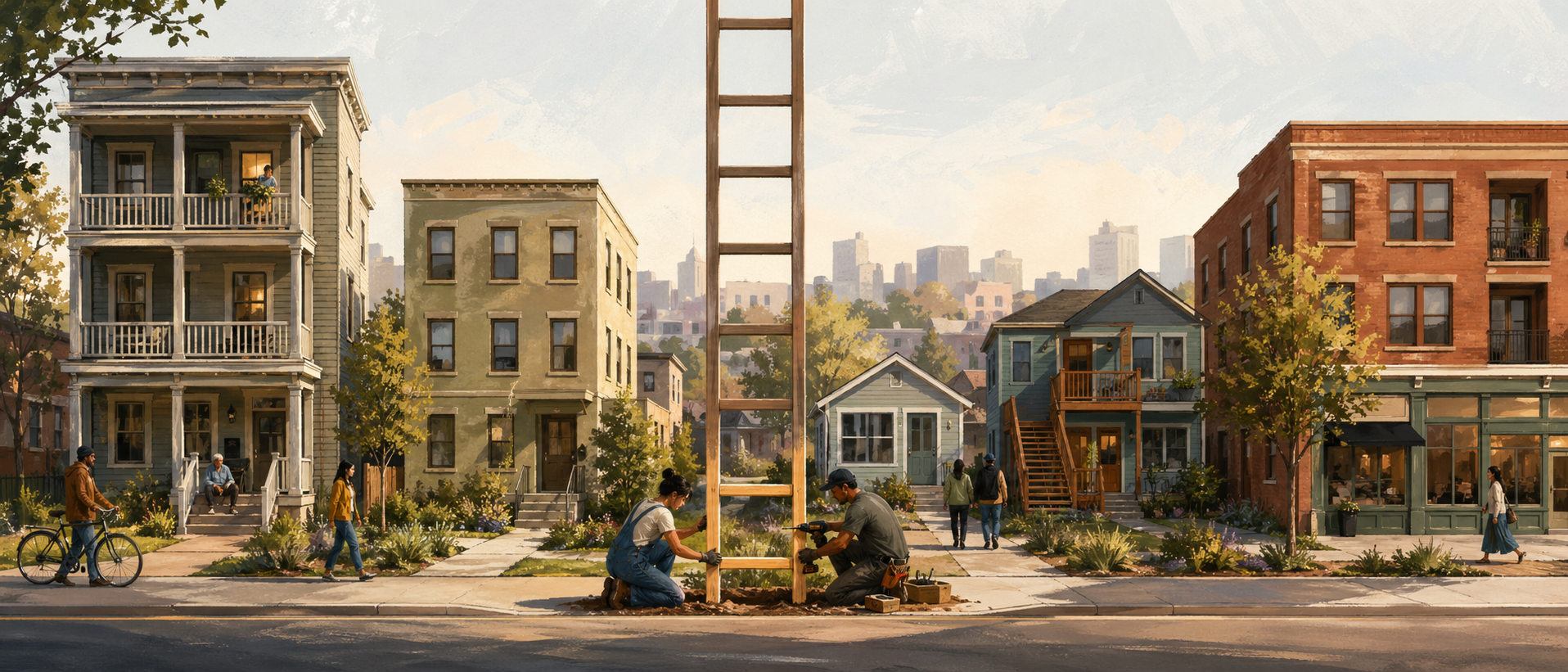
What happened to the bottom rung of the housing ladder?
Some of my thoughts in response to another great piece from The Pew Charitable Trusts and Alex Horowitz. For much of the 20th century, many Americans with very low incomes could still find a private-market room they could afford. It may have been modest. It may have been small. It may have had a shared bathroom or kitchen. But it was shelter. It was a foothold. It was a place to sleep indoors while trying to hold the rest of life together.
Over time, many cities regulated that housing out of existence.
Single-room occupancy hotels, boardinghouses, small apartments, residential hotels, dorm-style housing, accessory units, and roommate-based arrangements were often treated as nuisances to eliminate rather than as essential pieces of a functioning housing ecosystem.
That does not mean we should romanticize unsafe or exploitative housing. We should not.
But we also need to be honest: when the only legal options are expensive, fully self-contained units built to increasingly costly standards, we should not be surprised when the poorest households are left with no legal option at all.
A serious homelessness strategy has to include shelters, services, mental health care, addiction treatment, and supportive housing. But it also has to confront the basic market reality that people need housing at many price points, including price points far below what conventional new apartments can provide.
The answer is not to recreate the worst parts of the past. The answer is to legalize the best modern version of the missing bottom rung:
Modern SROs.
Co-living.
Small apartments.
ADUs.
Duplexes and fourplexes.
Rooming houses with clear safety standards.
Office-to-residential conversions that do not require every unit to function like a luxury one-bedroom apartment.
Reasonable rules for unrelated people sharing a home.
The key insight is this: affordability is not only a subsidy problem. It is also a permission problem.
We have spent decades making the cheapest forms of housing illegal, difficult, or financially impossible to produce. Then we are shocked when people at the lowest end of the income spectrum cannot find housing.
If we want fewer people living outside, we need to rebuild the housing ladder from the bottom up.
That means legalizing more modest, flexible, incremental, and naturally lower-cost forms of housing, not as a replacement for public investment or services, but as a necessary foundation for any serious housing strategy.