
Missing Middle Housing
By: Chris Allen
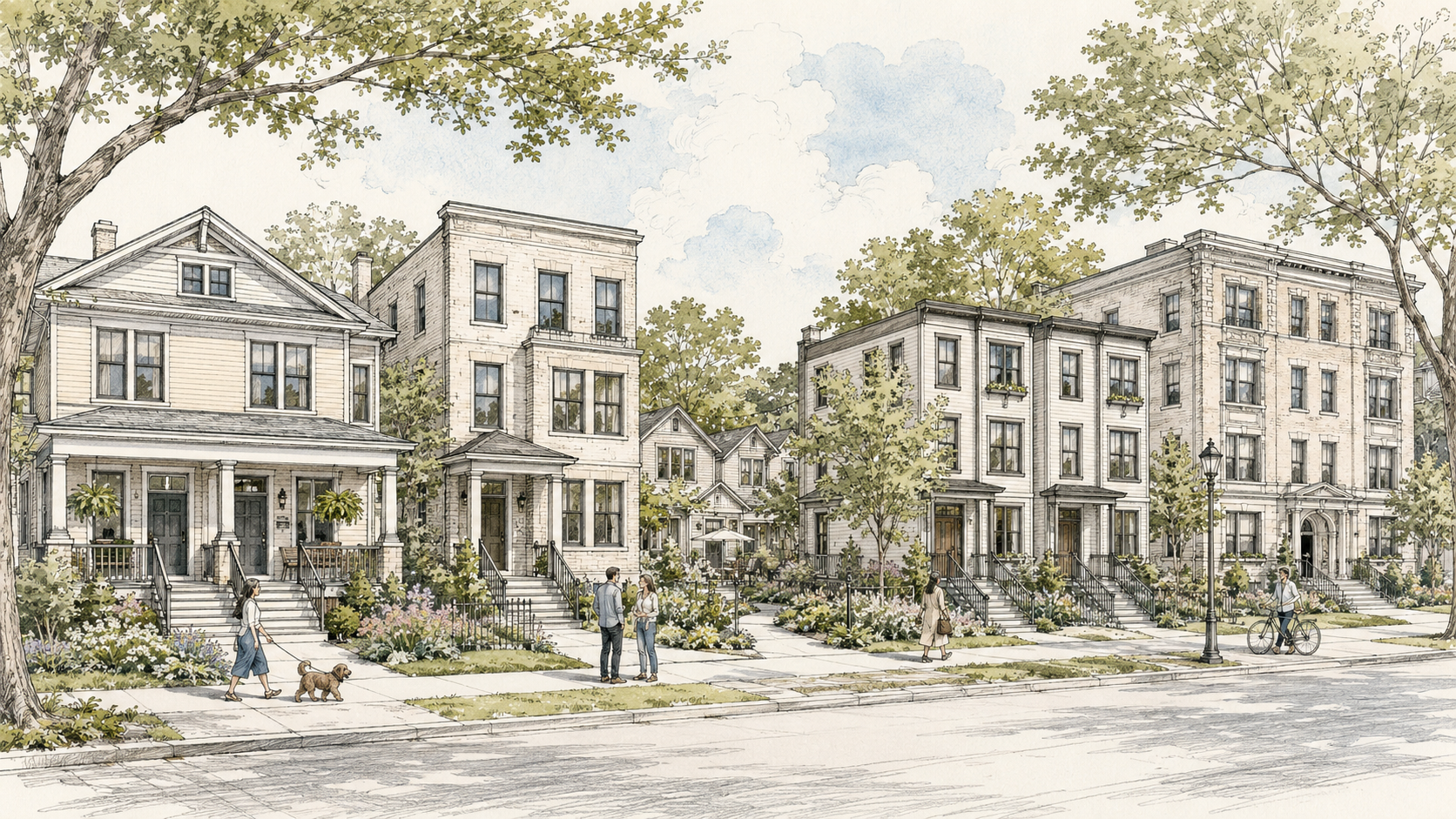
Missing Middle Housing is the range of house-scale, multi-unit housing that sits between detached single-family homes and large apartment buildings. It includes duplexes, triplexes, fourplexes, cottage courts, courtyard apartments, townhouses, live-work buildings, and small apartment buildings. The term was coined by Daniel Parolek of Opticos Design to describe housing types that are “compatible in scale with detached single-family homes” while providing more choices in walkable neighborhoods.
For IncDev, Missing Middle Housing is not just a set of building types. It is a development pattern. It is the way many of North America’s best neighborhoods were built before zoning, finance, and development practice pushed communities toward two extremes: detached single-family subdivisions on one side and large apartment complexes on the other. IncDev describes its work as helping make Missing Middle Housing “legal and straight-forward for local small developers,” which is the heart of the issue: this housing has gone missing not because people stopped needing it, but because the rules and systems for producing it became too difficult for ordinary local builders to navigate.
Missing Middle Housing matters because it gives communities more ways to grow without requiring dramatic neighborhood transformation. A duplex on a corner lot, a fourplex near a main street, or a cottage court on an oversized parcel can add homes gently, using land and infrastructure that already exist. These buildings support more attainable price points, more rental and ownership choices, more aging-in-place options, and more customers for local businesses, transit, schools, and civic institutions. Our friends at CNU frame Missing Middle Housing as a set of housing types that help meet demand for walkable urban living while supporting locally serving retail and public transportation.
Much of the case for Missing Middle Housing is also fiscal. A financially strong city needs neighborhoods that can mature, adapt, and generate enough private wealth to maintain public infrastructure over time. Strong Towns describes Missing Middle development, from duplexes to cottage courts to small apartment buildings, as an indispensable part of resilient, adaptable cities that can pay their bills. When every neighborhood is frozen at one unit per lot, the community limits both housing supply and the natural next increment of private investment. The result is often higher housing costs, stagnant neighborhoods, and a local development culture that depends too heavily on large, infrequent projects.
The policy lesson is that Missing Middle Housing cannot simply be praised in comprehensive plans. It has to be made legal, financeable, and buildable. Many cities say they want housing choice while maintaining zoning codes that require large lots, excessive parking, suburban setbacks, low lot coverage, complicated public hearings, or density limits that make small projects infeasible. Even when missing middle is technically allowed, the approval process can be so uncertain that only large developers with specialized consultants can participate. That defeats the purpose. The goal should be a system where a local builder, architect, tradesperson, nonprofit, faith community, or property owner can understand the rules and pursue a small project without taking on unreasonable entitlement risk.
IncDev’s position is that communities should allow the next increment of development by right in every neighborhood. That does not mean every lot becomes an apartment building. It means a single-family lot can become a duplex, a duplex can become a fourplex, a deep lot can become a cottage court, and a neighborhood near a corridor or center can support small apartment buildings and mixed-use buildings. Strong Towns expresses this principle as allowing “the next increment of development intensity” by right in every neighborhood. This is not radical; it is how traditional neighborhoods grew for generations.
Good Missing Middle policy should focus on form, feasibility, and implementation. Cities should legalize house-scale buildings, remove unnecessary parking mandates, allow reasonable lot coverage and building depth, permit multiple units within familiar neighborhood forms, simplify approvals, and align building codes, utility rules, and financing expectations with small projects. Pattern books, pre-approved plans, predictable zoning standards, and small developer training can help turn policy reform into actual housing. Recent work on Sacramento’s citywide Missing Middle strategy, shows how cities are beginning to pair zoning reform with practical tools such as calibrated floor-area rules to make smaller-scale housing more feasible.
Missing Middle Housing should not be treated as a silver bullet for affordability. It will not replace deeply subsidized housing, tenant protections, or the need for broader zoning and permitting reform. But it is one of the most important tools for rebuilding a healthy housing ecosystem. It allows more people to live in existing neighborhoods, creates opportunities for small developers, supports local wealth-building, and gives cities a more financially productive development pattern. Most importantly, it helps communities move away from a brittle housing system built around limiting options and toward a flexible system where neighborhoods can evolve, one good building at a time.
Best supporting links
IncDev — Our Work
IncDev’s direct framing of making Missing Middle Housing legal and straightforward for local small developers.
https://www.incrementaldevelopment.org/workCNU — Missing Middle Housing
A New Urbanist overview of why Missing Middle Housing supports walkable communities, housing choice, local retail, and transit.
https://www.cnu.org/our-projects/missing-middle-housingStrong Towns Action Lab — Missing Middle Housing: Top Content
Strong Towns’ practical framing of Missing Middle Housing as part of resilient, adaptable, financially productive cities.
https://actionlab.strongtowns.org/hc/en-us/articles/11811916958740-Missing-Middle-Housing-Top-ContentStrong Towns Action Lab — Core Campaign: Incremental Housing
The “next increment of development intensity” principle, which is one of the best policy frames for Missing Middle reform.
https://actionlab.strongtowns.org/hc/en-us/sections/11668881438868-Core-Campaign-Incremental-HousingCNU Public Square — Citywide Strategy to Promote Missing Middle Housing
A recent example of citywide Missing Middle implementation through Sacramento’s strategy and Opticos’ work.
https://www.cnu.org/publicsquare/2026/04/21/citywide-strategy-promote-missing-middle-housing