
America’s Transit Problem Is Really a Land Use Problem
By: Chris Allen
The Guardian recently published a useful piece on how far American cities lag behind their global peers on public transportation.
One number from the article jumped out: bringing major American cities up to “world-class” transit standards would require roughly $4.6 trillion over 20 years.
That sounds enormous.
Until you compare it with the roughly $6.3 trillion the United States is projected to spend on highways over that same period.
That comparison is clarifying because it reveals something important: America’s transportation problem is not simply a funding problem. We are already spending vast sums of money on transportation. The real question is what kind of transportation system we are choosing to build — and what kind of places that system is designed to serve.
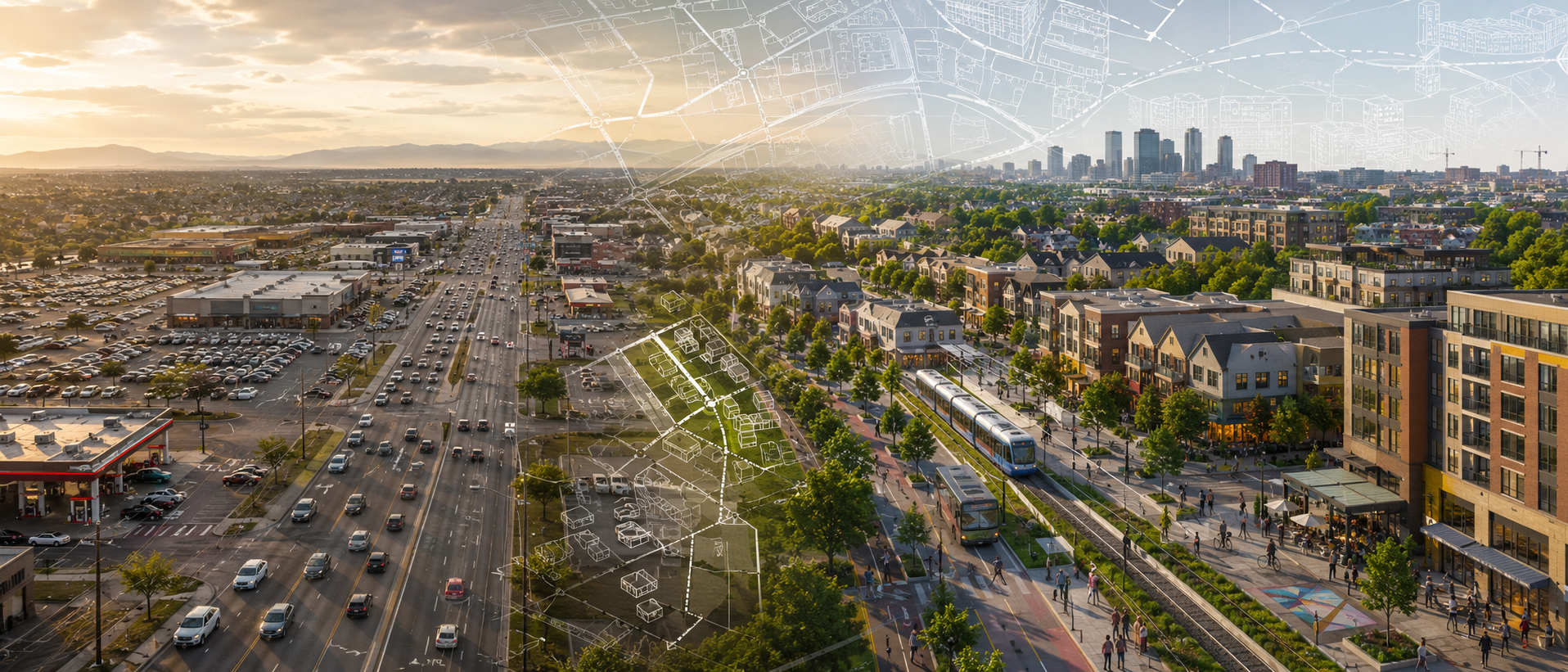
For decades, we have made a long series of choices about what kind of communities we are going to allow. We have built a system that assumes nearly every adult will own a car, nearly every trip will happen by car, and nearly every destination will be designed around the movement and storage of cars.
Then, after creating places where transit is almost impossible to operate well, we wonder why transit does not work better.
But America’s transit problem is not just a transit problem.
It is a land use problem.
It is a regulatory problem.
It is a development pattern problem.
And until we understand that, we are going to keep asking transit agencies to solve problems that were created by zoning codes, parking mandates, subdivision regulations, highway investments, and decades of public policy built around automobile dependence.
We Say We Want Better Transit, Then We Make Transit-Supportive Places Illegal
Most Americans do not live in places where transit can be a practical, reliable, everyday option.
That is not because Americans are uniquely opposed to public transportation. It is not because buses or trains are inherently incompatible with American life. It is because we have made it illegal, difficult, or financially unrealistic to build the kinds of places where transit works best.
Good transit needs proximity.
It needs enough people living, working, shopping, and gathering within a short walk of a stop or station. It needs connected streets. It needs safe crossings. It needs destinations that are close together. It needs a public realm where walking to the bus does not feel like a punishment.
But in too many American communities, we have done the opposite.
We have separated homes from shops. We have separated jobs from neighborhoods. We have required large amounts of parking around nearly every building. We have limited many neighborhoods to one detached house per lot. We have made small apartment buildings, duplexes, fourplexes, accessory dwelling units, corner stores, and neighborhood-scale mixed-use buildings difficult or impossible to build.
📆 Want to help create more opportunities for housing of all types in your city? Join an upcoming IncDev training to learn how. Check out our events calendar.
Then we lay a bus route across that landscape and ask why it is not more useful.
A bus running through disconnected subdivisions, oversized parking lots, and six-lane arterials is being asked to perform a miracle.
A train station surrounded by surface parking, drive-throughs, and high-speed roads is not a transit-oriented place. It is a car-oriented place with a train stop nearby.
That distinction matters.
Because transportation is downstream from land use.
If we build places where every destination is far apart, every street is hostile to walking, and every building assumes private car access, then the transportation system has very few options. It will default to cars because the physical pattern leaves little else that can work.
Car Dependence Is Not Inevitable
One of the most damaging myths in American transportation is that our current system is simply the result of consumer preference.
The story usually goes something like this: Americans like cars. Americans want single-family homes. Americans prefer suburban development. Therefore, the system we have is just the market giving people what they want.
That story is incomplete at best.
Yes, many people like cars. Cars are useful. They provide flexibility, independence, and access, especially in rural areas and places where destinations are spread out. This argument should not be about shaming people for driving. In many American communities, driving is not really a choice. It is a requirement.
But that is exactly the point.
Car dependence is not the same thing as car preference.
When zoning codes ban most housing types, when parking mandates increase the cost of every building, when local review processes make small infill projects slow and risky, when street design prioritizes vehicle speed over human safety, and when public investment overwhelmingly favors highway expansion, the outcome is not a free market. It is a heavily regulated, publicly subsidized system that produces car dependence.
We should be honest about that.
People are not choosing between a car-oriented landscape and a complete neighborhood served by reliable transit. In many places, the complete neighborhood is illegal. The corner store is illegal. The small apartment building is illegal. The backyard cottage is illegal. The gentle increase in housing near a bus stop is illegal. The small mixed-use building that would make the neighborhood more walkable is illegal.
Then we look at the resulting pattern and call it demand.
A better question is: what would people choose if we allowed more options?
What would happen if more families could live near jobs, schools, shops, parks, and services? What would happen if more neighborhoods could add homes incrementally over time? What would happen if we made it normal again for daily needs to be close to where people live?
That is the conversation we need to have.
The Hidden Cost of Making Driving Mandatory
The cost of car dependence is often hidden because it is spread across households, local governments, public agencies, and future maintenance obligations.
Families pay for vehicles, fuel, insurance, repairs, financing, and maintenance. They pay with time lost in traffic. They pay with stress. They pay when a teenager needs to be driven everywhere. They pay when an elderly parent can no longer drive. They pay when a job opportunity is technically available but practically unreachable without a car.
Local governments pay for roads, signals, drainage, utilities, emergency response, and long-term maintenance. They pay to extend infrastructure farther and farther outward. They pay to maintain wide roads and low-productivity development patterns that often do not generate enough tax base to cover their long-term obligations.
Communities pay in the form of crashes, pollution, poor public health, social isolation, and the loss of small-scale local commerce.
And transit agencies pay by being asked to serve places that were never designed to support efficient transit.
This is why simply adding more transit funding, while necessary, is not enough. If the underlying development pattern remains unchanged, transit will continue to struggle. We will spend more money trying to overcome a built environment that is working against us.
That does not mean we should wait to invest in transit. We should invest now. But we should also stop undermining that investment with land use rules that make transit less effective.
Housing Scarcity Makes Transportation Worse
The transportation conversation is also inseparable from housing.
When communities restrict new housing in desirable, job-rich, amenity-rich places, people do not disappear. They move farther away. They accept longer commutes. They drive more miles. They spend more of their income on transportation. They become more dependent on regional highway systems.
Housing scarcity creates transportation demand.
If a teacher, nurse, tradesperson, service worker, young family, or older resident cannot afford to live near the places where they work or participate in daily life, the transportation system absorbs the consequences. More cars. Longer trips. More congestion. More emissions. More household financial stress.
This is why housing reform is also transportation reform.
Legalizing more homes in more places is not just about affordability in the narrow sense. It is about access. It is about allowing people to live closer to opportunity. It is about making existing infrastructure work harder. It is about giving transit a fighting chance.
That does not mean every neighborhood needs to become a high-rise district. In most places, the most important reforms are much more modest: allow duplexes, triplexes, fourplexes, ADUs, small apartment buildings, cottage courts, small lots, and mixed-use buildings on corridors and near transit. Let neighborhoods evolve in small increments.
This is not radical. It is how many of our most beloved neighborhoods were built before modern zoning made them illegal.
The Path Forward Is Not Complicated, But It Is Politically Hard
The basic policy direction is clear.
We need to legalize more housing types.
We need to allow neighborhood-scale mixed use.
We need to end excessive parking mandates.
We need to make small infill projects easier to finance, permit, and build.
We need to design streets for safety, access, and value creation, not just vehicle speed.
We need to stop treating highway expansion as the default response to every growth problem.
We need transit service that is frequent, reliable, legible, and useful for daily life.
And we need to rebuild the local capacity to deliver better places.
That last point matters more than it often gets credit for.
Changing the code is necessary, but it is not sufficient. If a city legalizes missing middle housing but has no local builders who know how to deliver it, no lenders comfortable financing it, no staff familiar with reviewing it, and no small developers able to navigate the process, reform will underperform.
The work is not just to change what is allowed. The work is to rebuild the ecosystem of people and institutions capable of producing better places.
That means small developers, tradespeople, architects, planners, engineers, lenders, city staff, elected officials, neighborhood leaders, and local advocates all have a role to play.
A community that wants a different development pattern needs more than a new ordinance. It needs local capacity. It needs people who can take an underused lot, an aging commercial building, a vacant parcel, or a tired strip corridor and turn it into the next useful increment of a stronger neighborhood.
That is how change compounds.
Not only through megaprojects.
Not only through billion-dollar transit expansions.
But through thousands of small decisions that make neighborhoods more complete, more productive, more walkable, and more resilient.
Better Transit Starts With Better Places
The Guardian article is right to highlight America’s transit deficit. We should be embarrassed by how poorly many of our largest, wealthiest metro areas serve people who cannot or do not want to drive.
But the deeper failure is this: we have tried to build transit on top of an anti-urban land use system.
We cannot regulate for sprawl and then be surprised by car dependence.
We cannot mandate parking and then wonder why everything is surrounded by parking lots.
We cannot ban small-scale housing and then complain that transit lacks riders.
We cannot separate every use and then expect short trips.
We cannot widen roads for speed and then expect people to feel safe walking across them.
Transportation, land use, and regulation are all part of the same system. When they are aligned around proximity, access, and incremental development, communities become more affordable, more resilient, and more financially productive. When they are aligned around separation, speed, and automobile dependence, communities become more expensive to maintain and harder to navigate without a car.
The goal is not to punish driving.
The goal is not to pretend cars will disappear.
The goal is to stop making car ownership a prerequisite for full participation in American life.
A prosperous city should not require every commute, grocery trip, school drop-off, doctor’s appointment, and social visit to happen by private automobile.
A strong community gives people options.
It creates proximity.
It lets the neighborhood do more of the work.
It allows homes, shops, schools, services, parks, workplaces, and transit to reinforce each other.
That is the path forward.
Not transit in isolation.
Not zoning reform in isolation.
Not housing reform in isolation.
But a coordinated effort to make better places legal, practical, and financially possible again.
Better transit starts with better places.
And better places start with making them legal again.