
Faculty Spotlight: Eric Kronberg

As a faculty member with IncDev, Eric Kronberg brings with him 28 years of architecture and small-scale development experience, a love for human-centered urbanism that has been with him from an early age, and a commitment to helping incremental developers learn and successfully navigate the rules and barriers they face in their communities.
At the age of one, Eric’s father moved his family from a walkable community in Grosse Point, Michigan to suburban Ohio. He recalls growing up “starved” for urbanism, for rich, diverse and walkable places. Knowing there was more to the world than suburbia, he worked hard in school to get into Tulane University where he studied architecture. After graduation and a brief stint in Florida, he settled in Atlanta where he has been working ever since.
Eric loves Atlanta and likes to push back on the stigmas associated with the big city, namely the highway, consistent traffic and suburban sprawl. The core of Atlanta, he says, is incredible with plenty of historic buildings and homes. And the city is full of amazing neighborhoods, becoming increasingly more connected through a growing bike network. Sprawl is real but many neighborhoods still have a mix of residential and commercial properties giving them that village dynamic that makes a place loveable.

A revitalized Georgia Avenue in the Summerhill Neighborhood
After working for various architects’ firms, Eric embarked on his own, setting up Kronberg Urbanists Architects (KUA) with a business partner in 2003, focusing from the start on small, in-fill development projects. Over the years, KUA has taken on several notable projects, including the revitalization of Georgia Avenue in Summerhill Neighborhood, a formerly African American neighborhood that had suffered for decades after “Urban Renewal” and stadium-related development demolished homes and businesses and displaced thousands. Today the Avenue boasts an improved commercial fabric and several new businesses, including the office building where KUA is based.
In 2023, KUA launched Finley Street Cottages, a housing project in the Edgewood Neighborhood of Atlanta. This car-lite neighborhood features 16 units across two .33-acre lots with plenty of shared green space and a central courtyard. As an example of subsidy-free, workforce housing that required no rezoning, the project won a Merit Award in the 2024 CNU Charter Awards and was a finalist for the Healthy City Design Awards in 2025.
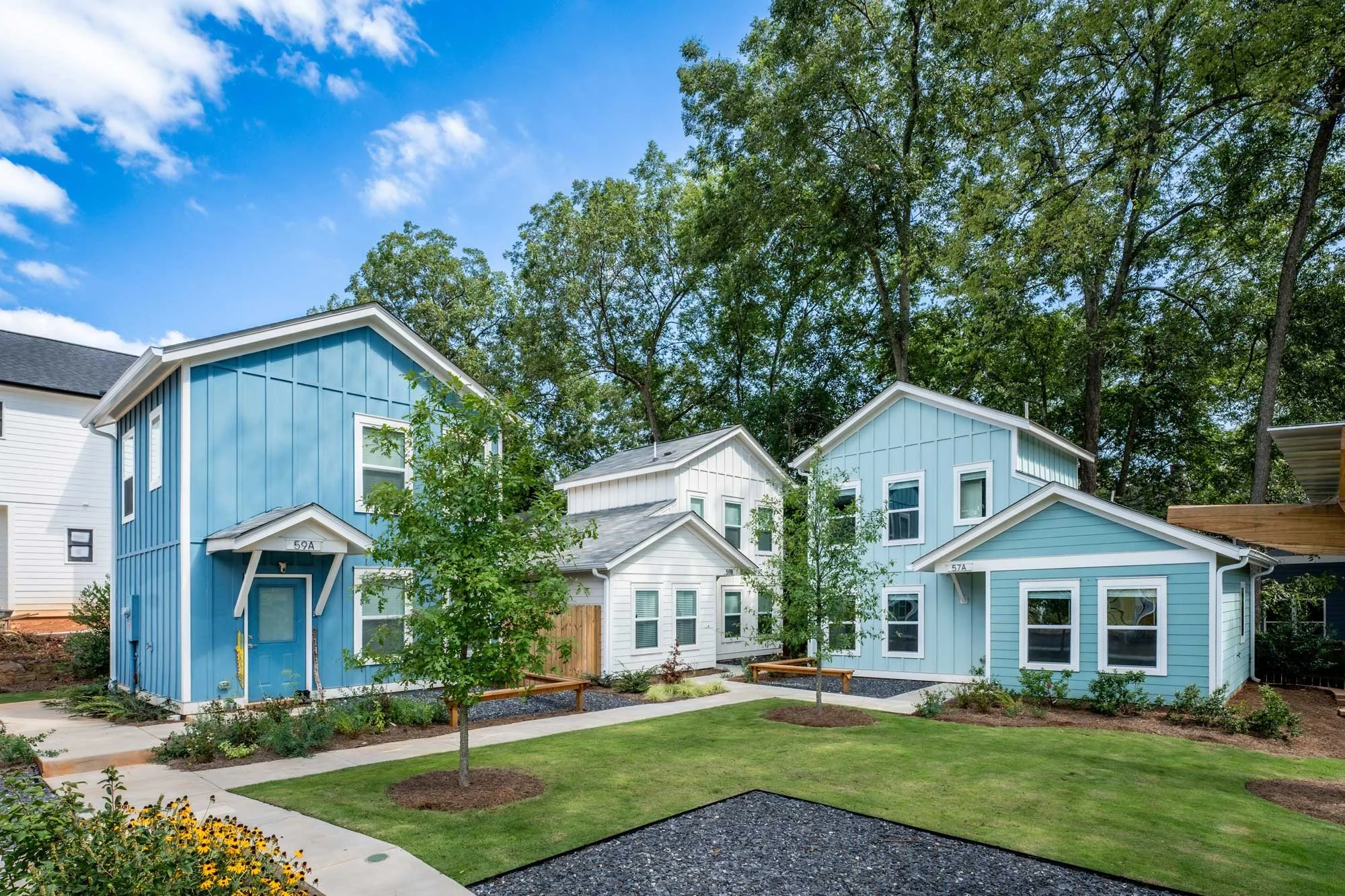
Finley Street Cottages
Eric and his firm have also worked in other cities, building affordable housing in New Orleans and developing various resources for the City of Chattanooga as part of their effort to revitalize a former highway site into affordable housing. Kronberg and his firm leveraged their expertise of design, zoning and financial constraints to design patterns for duplexes, quadplexes, sixplexes, and small multi-unit complexes. The Power Plans, empowered developers to build cost-efficient and cost-predictable neighborhood-scaled housing. The resulting 58 resulting buildings from these plans went on to win the Jack Kemp Excellence in Affordable and Workforce Housing Award in 2024
Although he had already been working as a small-scale developer before attending an IncDev training in 2015, Eric said it helped him better understand how all the pieces of a project fit together – the design side but also the zoning and stormwater permissions and parking strategies, just to name a few. Since joining IncDev as faculty, he’s been able to leverage that role to do more research, gaining clarity along the way about how to contextualize various challenges, the barriers developers face, and the tools they need to succeed.
Along with his team at KUA, Eric has poured those observations and years of experience into two new resources. The Housing Catalogue is a collection of housing designs KUA has crafted over the years that developers can use to build housing projects that “pencil out” financially. The catalogue features four types of housing types – Cottages, Packs, Rows and Plexes – that can be arranged on larger sites, usually at a density of 12-18 units per acre.
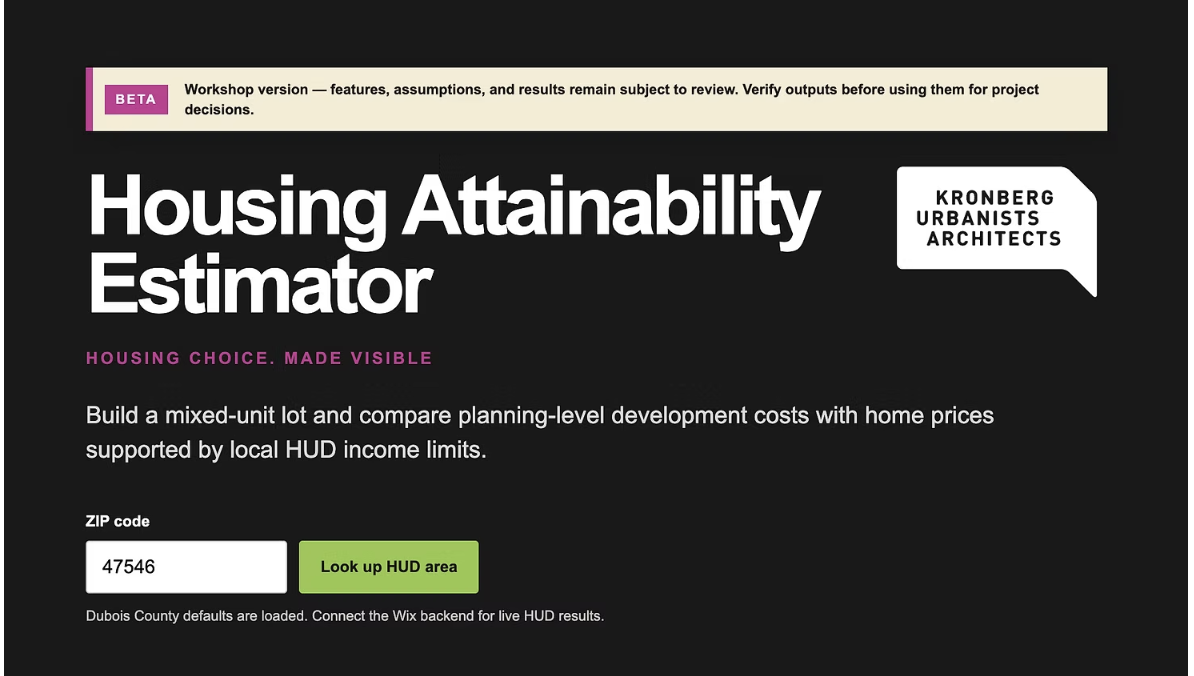
The Housing Attainability Estimator is a tool on the KUA website that helps users visualize how it is financially beneficial to put multiple units in one building and multiple buildings in a lot. According to the KUA website, the tool allows users to assemble a mix of housing types from the KUA housing choice catalogue, adjust basic cost assumptions, and compare the resulting planning-level costs with benchmarks derived from HUD income-limit area data. While not a replacement for a Proforma, the tool makes it easy to visualize the effect of land use policy, the benefit of building multiple units on one lot and identify paths of additional study and research.
For Eric, these tools embody a rigorous commitment to making in-fill development easier to build, easier for cities, non-profits and developers to choose projects, envision the end result, get ahead of possible rezoning and regulatory requirements and know exactly how the project will pencil out financially.
Ultimately, he wants in-fill development to be as easy as baking a cake: choosing ingredients (selecting patterns from the catalogue), baking the cake (getting a design plan) and icing the cake (receiving construction plans)...a straightforward process that makes missing middle housing easy to build and easy to love.
Thanks to video creator and storyteller Hope Henchey for some of the reporting for this article.