
Cleveland Housing Innovation District An Exciting Path Forward
By: Chris Allen
Cleveland is showing what a new local housing playbook can look like. Now comes the hopeful work of building the people and systems that can make it real.
Across the country, local leaders are realizing something important: housing cannot be treated as a standalone problem. It is not separate from economic development, infrastructure, small business growth, neighborhood repair, public finance, or whether the next generation of families can stay in the communities they love. Housing is the connective tissue of local prosperity.
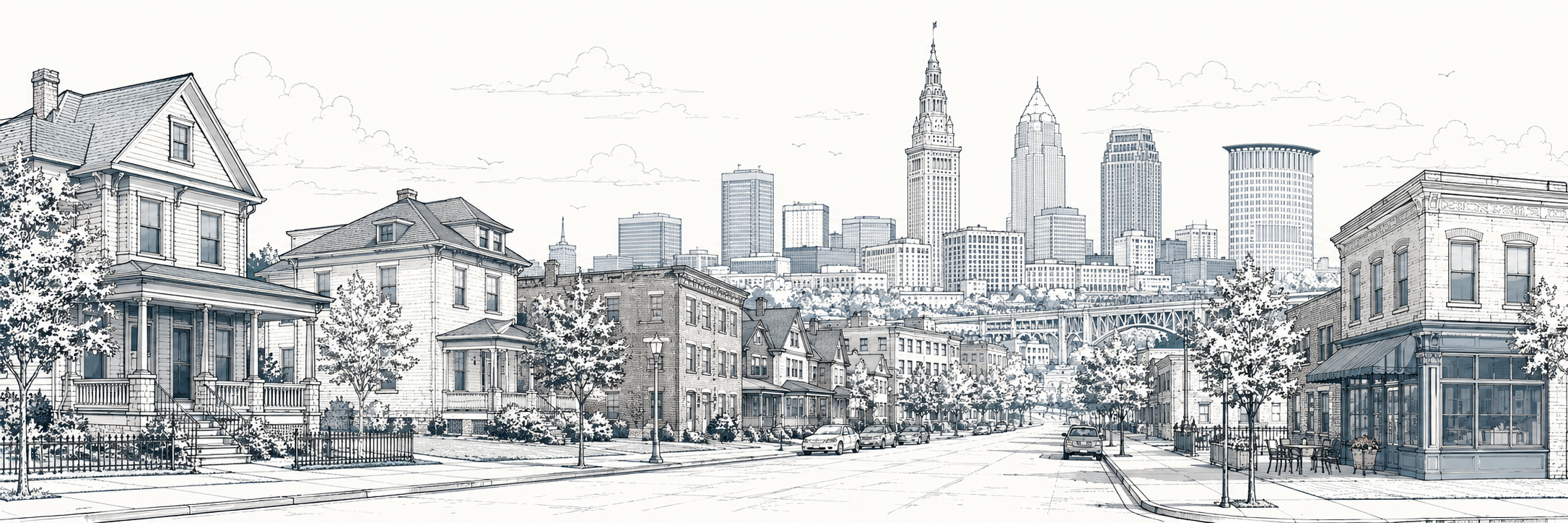
That is why Cleveland's new Housing Innovation District is worth celebrating. The city is moving forward with a focused strategy for several historically disinvested East Side neighborhoods, including Hough, Central, and St. Clair-Superior—neighborhoods that carried Cleveland forward for generations while being denied the investment they deserved. What makes the effort remarkable is how it brings together tools that many cities talk about separately but rarely align: form-based code, waived or reduced permit fees, pre-approved housing plans, new housing on city-owned vacant lots, home repair and storefront support, and tax increment financing that lets future growth pay for the streets, sidewalks, utilities, and parks that growth requires. Cleveland is even pairing this housing strategy with an industrial one, connecting new homes to the more than 2,500 jobs envisioned along the new Cleveland Midline corridor.
What's inspiring is not that every city should copy Cleveland's exact model. Every community has its own history, politics, market conditions, land patterns, and institutions. It's that Cleveland is asking the right kind of question. Not simply, "How do we get more units?" but, "How do we redesign the local development system so that investment strengthens neighborhoods, reduces barriers, supports existing residents, and builds long-term local opportunity?" That is the question more cities can begin to ask themselves.
The old housing playbook is not enough
For decades, too many communities have treated housing as something that happens somewhere else, by someone else, at a scale most local people can barely understand. A large developer arrives, a big project gets negotiated, a subsidy package is assembled, and a public hearing turns into a fight. A few units get built—or maybe they don't—and then the community waits for the next outside actor to arrive.
That model can produce housing, and sometimes it is necessary. But it does not build a deep bench of local developers. It does not help the person who owns a vacant lot understand what's possible, or train the contractor who could become a small builder, or teach the local banker how to evaluate a fourplex or a phased infill project. It does not give city staff a practical way to move small projects through the system without reinventing the wheel each time. Most importantly, it does not create a local culture of development.
And that is what many communities are missing. They may have land, plans, zoning reform, philanthropic interest, and elected officials who want to act. They may have residents who want vacant lots filled, main streets repaired, and more attainable places to live. What they don't yet have is enough people who know how to turn those opportunities into real projects. That is the implementation gap—and it is one any community can decide to close.
Cleveland's plan points toward the next frontier
The most powerful part of Cleveland's Housing Innovation District is not any single tool. Waiving permit fees helps, but it will not solve a housing shortage on its own. Form-based code can make better development legal, but legality does not equal feasibility. Vacant lots are an opportunity only if someone can acquire, finance, entitle, and build on them. A TIF district can pay for infrastructure, but infrastructure needs a pipeline of real projects to support, and pre-approved plans reduce friction, but plans do not build themselves.
The real breakthrough is that Cleveland treats these pieces as part of one system. That is the shift any local government can make. Housing reform is not just a code amendment, a funding program, a plan goal, or a ribbon cutting. It is the work of aligning the local ecosystem—city staff, elected officials, planners, building officials, lenders, community development organizations, neighborhood leaders, small builders, architects, contractors, property owners, foundations, and emerging developers—so that good projects happen more often, with less friction, by more people, in more neighborhoods. When those people are aligned, small projects become possible. When they are not, even the best policies sit on the shelf.
The missing piece is local development capacity
At the Incremental Development Alliance, we believe every community already has the people who could become part of the solution. They are the person who owns a small building downtown, the contractor who has thought about building two or three homes but isn't sure how to structure the deal, and the architect who understands neighborhood form but wants more fluency in development finance. They are the local banker who wants to support housing but hasn't seen enough small infill projects to underwrite them with confidence, the planning director working to make the code easier to use, and the elected official who wants more housing that still feels like it belongs. They are the nonprofit leader who sees the vacant lots and empty storefronts, and the resident who loves their neighborhood and wants reinvestment to benefit the people who stayed.
These are not side characters in the housing story. They are the people who can make the next housing playbook real. What they need are tools, training, examples, and a shared language—a working understanding of how small-scale development actually happens: site selection, zoning, acquisition, financing, construction costs, pro formas, risk, phasing, partnerships, and long-term stewardship. They need to see that development is not magic. It is a learnable civic skill, and that realization is where a new playbook begins.
Neighborhood reinvestment should build wealth from within
One of the most important tensions in any housing innovation district is the fear that new investment will lead to displacement. That fear is real and should not be dismissed. In many communities, residents have watched investment arrive only after they were no longer positioned to benefit from it. So the question is not whether neighborhoods need investment—they do. The question is who gets to participate in it, who benefits, and whether the community is building systems that let existing residents and local actors shape what comes next.
That is where incremental development matters most. Small-scale development is not automatically equitable; it still requires intention, care, and good policy. But it opens far more doors for local participation than a system dominated only by large, highly capitalized projects. A neighborhood with many small developers, local builders, mission-driven lenders, community-based organizations, and informed property owners has more ways to shape its own future. It can fill a vacant lot with a duplex, bring an old storefront back to life, add a small apartment above a shop, or repair a house before it is lost. It can build a cottage court, a fourplex, a row of small homes, or a mixed-use building that fits the block—and it can do this not once, but again and again, building local knowledge with every project. That is how neighborhoods grow stronger from within.
Cities can move from permission to production
A growing number of cities are reforming their rules. They are allowing accessory dwelling units, legalizing duplexes and small multifamily buildings, reducing parking mandates, creating pre-approved plans, and updating zoning to support mixed-use, walkable neighborhoods. This is good and necessary work. But communities are learning a hopeful, demanding lesson: allowing better development does not automatically produce it. A zoning reform can open the door, but someone still has to walk through it.
That means the next step is to think beyond permission and toward production. Who is ready to build under the new rules? Do local lenders understand the product types the city now allows, and can city staff process small projects efficiently? Are there local developers who know how to test feasibility before they buy land, and builders who can deliver at the scale the code now permits? Are public incentives designed for the projects the community actually wants, and are foundations helping build durable capacity rather than funding one-off projects? These are the questions that turn a housing innovation district from a well-intentioned plan into a living strategy.
The opportunity for every city
Cleveland's Housing Innovation District is a local story, but the lesson is national. Every city has some version of this challenge. It may be a disinvested corridor with vacant lots, a downtown with empty upper floors, or a neighborhood where the zoning no longer matches the historic pattern. It may be a small town losing workers for lack of homes, a suburb trying to add gentle density without losing its sense of place, or a rural community where the gap between construction costs and appraised value makes new building nearly impossible. It may simply be a city that has adopted a housing plan but doesn't yet have the people, processes, and project pipeline to implement it.
In each case, the work is not only to attract development. It is to cultivate developers—not just big or outside or subsidized developers, but the many kinds a healthy neighborhood needs: small developers, emerging developers, neighborhood developers, mission-driven developers, local builders, property owners, and real estate entrepreneurs rooted in the place and ready to do the next good project. This does not replace large-scale affordable housing or major public investment where those tools are needed. It is the missing layer between policy ambition and neighborhood reality.
A new housing playbook will be built locally
The next housing playbook will not be written only in state capitols or federal agencies. It will be written in planning offices, community rooms, local banks, neighborhood corridors, small job sites, and city council meetings. It will be written by the city staff member who makes the permit path clearer, the lender who learns to finance a small infill project, and the elected official who sees that gentle density can strengthen a neighborhood. It will be written by the foundation that funds capacity rather than just plans, and by the local developer who builds one good project and then teaches someone else how to do the next one. Above all, it will be written by communities that decide vacant lots should become homes, empty storefronts should become businesses, and growth should create opportunity for the people already there.
Cleveland is giving us a useful and genuinely hopeful example because it is treating housing as a system. That is the right instinct, and now the deeper, more exciting work begins. A housing innovation district is more than a district. It is a test of whether a city can build the local capacity to turn public goals into private action, community benefit, and real places where people can live, work, and put down roots. That is the work ahead for Cleveland, and for hundreds of communities across the country, and it is work worth doing.