
Alumni Story: JT Malasri

JT Malasri came to incremental development with an engineer’s understanding of infrastructure and a desire to see how all the pieces of a development project fit together. Before founding Malasri Engineering, he worked for a utility company, where he saw development largely from the perspective of utility infrastructure. That experience gave him insight into one important part of the process, but he did not have the opportunity to see the planning, financing, and land use decisions that shape a project from beginning to end.
In 2017, about a year after founding his company, Malasri attended an Incremental Development Alliance Boot Camp. He had learned about IncDev through the late Tommy Pacello, who was instrumental in bringing the organization to Memphis.
At the time, much of Memphis’s development activity focused on large catalytic or anchor projects. Malasri saw a need for smaller infill projects that could strengthen the city’s existing neighborhoods. He wanted to understand firsthand what it took to complete that kind of development and to receive informed critiques of a project he was already considering.
The Boot Camp helped Malasri understand that becoming a developer did not necessarily require access to enormous amounts of capital. His biggest takeaway was, “You don’t need a whole lot of capital to get started.”
He learned how residential loans could be used to finance smaller development projects. That still represented “a life-changing amount of money if you mess up,” but the risk was different from what a developer might take on with a larger project. Seeing how a smaller project could be financed gave Malasri confidence that incremental development was a risk worth taking.
The training also changed how he approached project design and financing. A developer should begin with the desired outcome in mind, he said, but should also “start the project with the financial instruments you’ll use in mind.” Instead of designing a large multifamily project and then trying to force it into a neighborhood or financing structure, Malasri began thinking about projects that could fit within both the physical and financial infrastructure already available.
Presenting his project to experienced developers during his IncDev training was especially valuable. Inviting others to examine the proposal and “poke holes through it” helped him identify potential problems and confirm that the basic concept was sound.
“You know what you know, and you know what you don’t know, but the part I’m always concerned about is what I don’t know I don’t know," Malasri explains. "That’s where being able to present the project at the end of the class and have actual developers [...] as the judges and the people who have done this before, kind of just throw all their different perspectives out there, kind of validated that, hey, this is a pretty sound project.”
Being surrounded by people who shared his interest in neighborhood-scale development also made the difficult parts of the work feel more manageable. “It’s a lot easier to do some of these hard things when you’re around other people who are passionate about the cause," he comments.
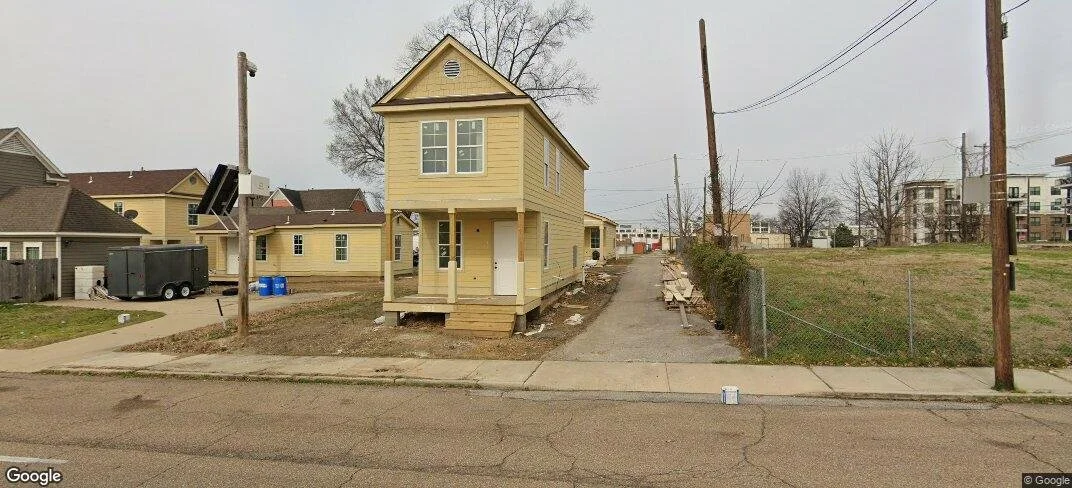
One of Malari’s cottages in process
Malasri put those lessons into practice with his Uptown Cottages, his first development project. He had acquired two long, narrow lots in Uptown Memphis in 2015 and revised his plans after attending the Boot Camp. The finished project consists of two narrow, modern primary houses and two accessory dwelling units (ADUs), creating four homes on two lots. [Watch this video created by Hope Henchey in partnership with IncDev to learn more about the Uptown Cottages.]
Before the project, the properties were vacant pieces of a neighborhood grid surrounded by single-family homes and other scattered parcels. Adding four housing units to the two lots improved the project’s financial feasibility and made market-rate rents more viable. It also demonstrated how additional housing could be incorporated into an existing neighborhood without requiring a large apartment development.
Andre Jones served as the contractor and had previously worked with the same project type. Malasri credited Jones with taking on much of the work needed to change policies that stood in the project’s way. “He’s got beers and pizzas for life on me because he took on a big heavy lift to change the policies himself.”
The myriad of challenges Malasri had to navigate with this project include requesting zoning variances, navigating complex entitlements, dealing with volatile lumber pricing, and addressing a veto from the fire marshal.
Malasri connected the process to a description of incremental development as trying to open a door secured by ten locks. In practice, he found that developers are often trying to open several doors at once. When financing, approvals, construction costs, and other conditions align, they have to be ready to move through whichever doors are open.
The project also faced some neighborhood opposition. “Most people don’t like change with some of the missing middle product types; it’s a little different than what they’re used to seeing, and so there is, I think, a little bit of opposition there,” says Malasri.
The neighborhood’s close-knit character could make introducing a less familiar housing type challenging, but it also created accountability. Neighbors would let Malasri know when a tenant had a code violation or when another issue needed attention. For Malasri, managing those relationships is part of finding the balance between financial feasibility and community responsibility.
“Our goal is to be a good neighbor, right, but also at the same time we’ve got to make the project work, and we’ve got to find that balance," he says.
At the most immediate level, Uptown Cottages replaced vacant lots with four new homes. Malasri also sees infill development as part of a much larger process of rebuilding a neighborhood’s population and economic base: “On a much bigger scale…the more property that you have in an area, the more tax base that there is in that area, and then the city will have more property taxes to help support the area. But also the more properties and more houses that you have in a specific area, the more people that you bring in, and then that will then allow for other types of developments or commercial businesses to start supporting that.”
Malasri believes the IncDev training is useful even for people who do not plan to become developers themselves: “Even if you’re on the policy side, land use side, closing side, presently doesn’t matter what, just to have a little more holistic overview of how what you do fits into that picture, I think is tremendously valuable, and so just do it. If you want to have a pivot and get into land development, it gives you the foundation to do that, but if you don’t, then at least you have a broad overview of what’s needed.”
Through the Uptown Cottages and the projects that follow it, Malasri hopes to fill in Memphis’s vacant land, strengthen the conditions needed for neighborhood businesses, and remove obstacles for the developers who come after him. At the center of that work is one guiding principle: “Our goal is to be a good neighbor.”

Want to see more innovative projects and meet developers like JT who are shaping the future of Memphis? Join us for our National Field Trip to Memphis, September 24-26, 2026. Learn more and sign up here.
Thanks to video creator and storyteller Hope Henchey for the reporting for this article.